Apollo flags used an L-shaped pole so they'd stay visible in vacuum. The visible 'wave' is fabric settling from being twisted into the rod during deployment. In any frame after the astronauts let go, the creases stop moving. A flag in vacuum with no rod would hang limp — and that's exactly why NASA engineered the rod.
We · Went
Dossier 001 · 1969 – 1972
Twelve people walked on the Moon.
Here's how we know.
A field guide to the most repeated conspiracy claims — answered with the physics, the photographs, and the 382 kilograms of lunar rock that came home.
12
Humans who walked on the lunar surface
382 kg
Lunar samples returned to Earth
6
Successful crewed landings
5
Retroreflectors still in active use
§ Claims & Counter-evidence
Five kinds of doubt. Thirty-nine claims. None of them new.
Pick a category, then tap any claim to read the verdict, the explanation, and where to verify it yourself.
The most common entry point: a still image looks wrong, therefore the whole program is wrong. Almost every one of these is a camera, lens, or lighting question — not a lunar one.
The lunar surface in direct sunlight is roughly as bright as a sunlit beach. Hasselblads were set for fast shutter speeds and small apertures to expose astronauts and equipment correctly. At those settings stars are far too dim to register — the same reason photos of a lit-up city at night show a black sky overhead.
SourcesNASA · Apollo Image Atlas ↗
On flat ground a single distant light source casts parallel shadows. The lunar surface is anything but flat — craters, rocks, and slopes tilt the ground under each shadow. Add the perspective distortion of a 60mm Hasselblad lens and parallel shadows photograph as if they're fanning. Recreate it in your backyard at sunset; you'll get the same effect.
The lunar surface reflects about 12% of sunlight in every direction. Anything standing on it sits inside a giant bounce card — the regolith fills the shadow side with soft, slightly warm light. Photographers call this 'reflected fill.' It's the same reason a person standing on fresh snow has a brightly-lit face even when the sun is behind them.
When a very bright object sits behind a thin black line on film, the silver halide crystals around the bright area over-expose and 'bleed' across the line. This is called halation. It happens with any film camera, and it only ever happens at bright/dark boundaries — which is precisely where the missing crosshairs occur. If the images were composited, the crosshairs would be missing everywhere, not just over white surfaces.
On Earth, dust, moisture, and air molecules scatter light and make distant objects fade to pale blue. The Moon has no atmosphere, so a mountain 5 kilometres away is as sharp and contrasted as a rock 5 metres away. Without that familiar haze cue, our brains interpret the scene as a flat studio backdrop. It's the same reason photos from high-altitude aircraft look 'fake': remove the air, and depth perception collapses.
High-resolution scans of visor reflections show the lunar module's distinctive shape, the photographer's own shadow, and the bright sun. No studio light fixture ever identified matches these reflections. In fact, the reflections are so detailed they've been used to reconstruct panoramic views of the landing sites.
Apollo missions landed in vastly different regions: maria, highlands, and rilles. Conspiracy comparisons use low-resolution crops, zoom mismatches, or photos from the same mission. High-resolution panoramas show completely different terrain profiles, crater counts, and ridge orientations at each site.
§ The Record
Six landings. Eighteen names. One verifiable timeline.
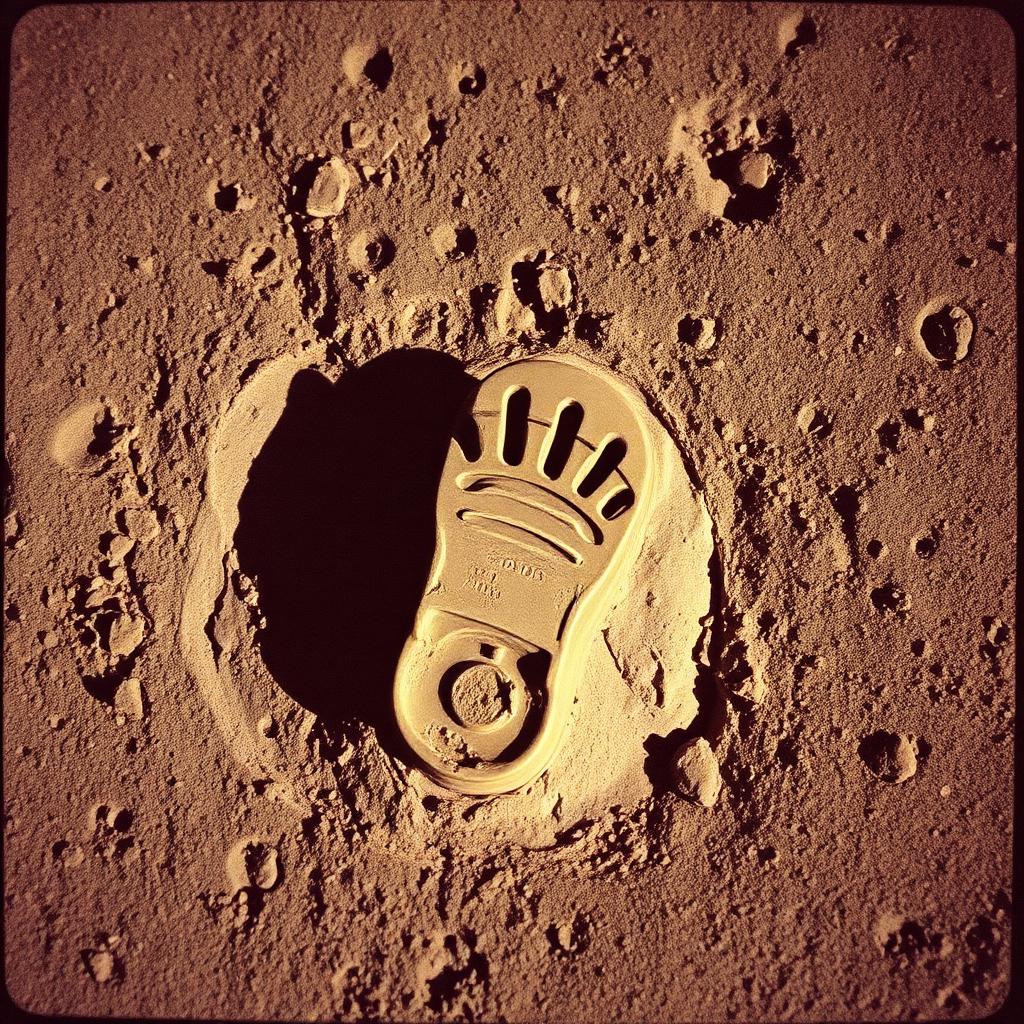
The fine-grained regolith holds an impression sharper than wet sand — and there's no wind, no rain, and no atmosphere to erase it. The prints are still there.
- Jul 1969Apollo 11First crewed landing — Sea of TranquilityArmstrong · Aldrin · Collins
- Nov 1969Apollo 12Pinpoint landing near Surveyor 3Conrad · Bean · Gordon
- Feb 1971Apollo 14Fra Mauro highlandsShepard · Mitchell · Roosa
- Jul 1971Apollo 15First lunar rover · Hadley RilleScott · Irwin · Worden
- Apr 1972Apollo 16Descartes highlandsYoung · Duke · Mattingly
- Dec 1972Apollo 17Geologist on the Moon · Taurus–LittrowCernan · Schmitt · Evans
A note before you argue with someone online
"Doubt is healthy. But the burden of proof sits with the claim that hundreds of thousands of engineers, the Soviet Union, and every astronomer since 1969 have all been wrong, or lying, for fifty-seven years."